
Relief, light and architectural scale
Stone murals made for the wall they will live on.
A successful stone mural is not a flat image transferred to a slab. Relief depth, panel joints, stone grain, viewing distance and the direction of light are designed together so the finished wall reads as one composition.
01Made to orderDrawings and references developed for stone.
02Cut and hand-finishedMachined geometry resolved at the carving bench.
03Coordinated supplyApproval, numbering and packing planned for the work.
From a single relief to a joined feature wall
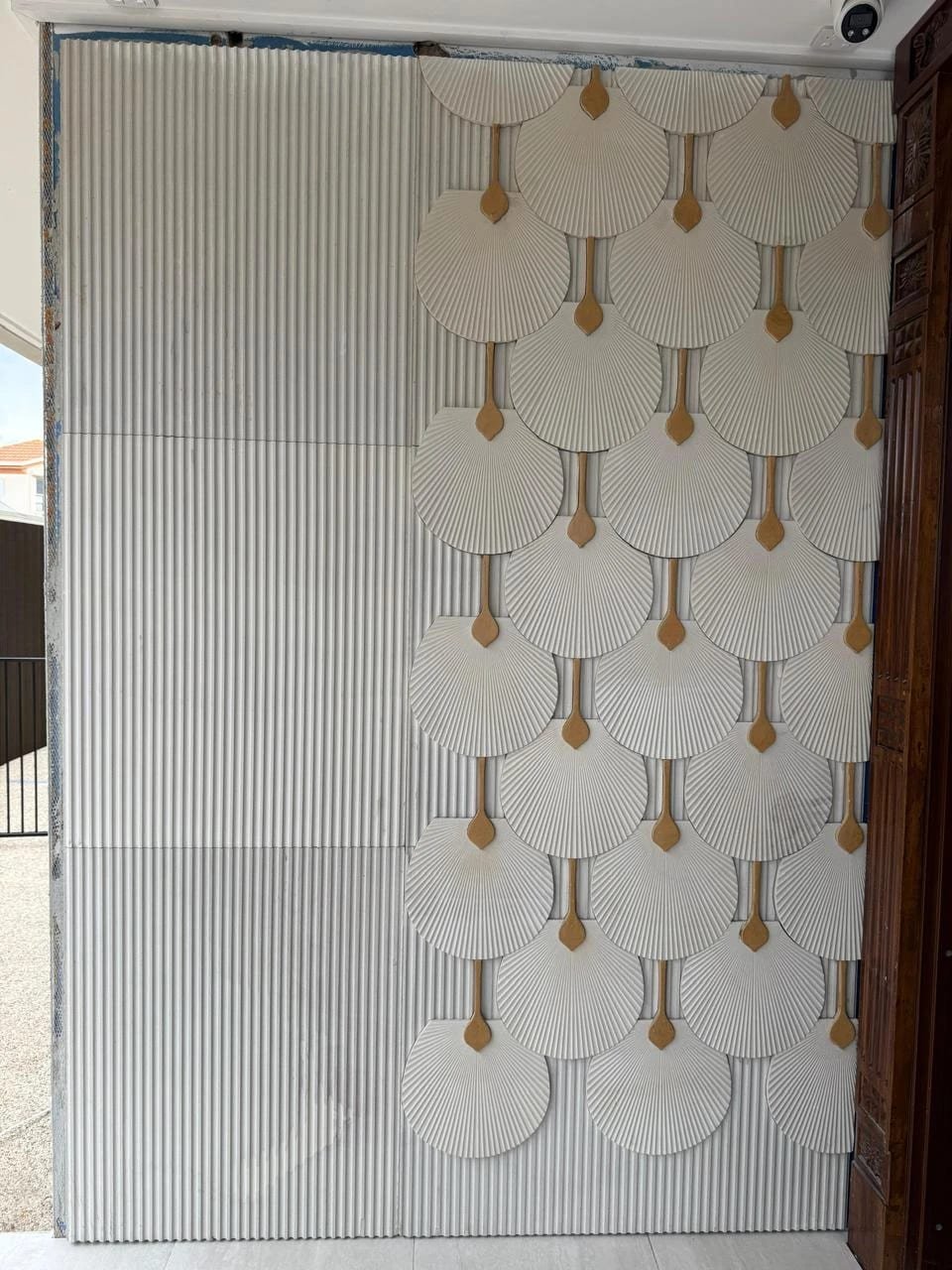
Stonegraph produces botanical, abstract, pictorial, sacred and geometric wall reliefs. The photographed collection includes banana leaves in sandstone, flowing contour panels in marble and travertine, a carved riverside city, Buddha reliefs, backlit limestone and a multi-panel marble-and-brass fan wall.
Large murals are divided where the composition and the stone allow it, not simply into equal rectangles. Joint positions, slab thickness, backing, fixing zones and the installation sequence are resolved before carving so that the assembly remains readable on site.
Choosing stone and relief depth
Marble holds a clean edge and can take polish, limestone gives soft depth and even shadow, sandstone carries a warmer granular surface, and travertine brings its own voids and direction. The best choice depends on the motif, exposure, scale and the finish the room needs.
Deep carving is not automatically better. A close-viewed residential panel often needs quieter depth than a lobby wall seen from across a room. Backlighting, grazing light and brass or stone inlay can create contrast without forcing every part of the design deeper.
- 3D relief and bas-relief
- Single-slab and multi-panel murals
- Interior feature walls and lobby stone
- Backlit relief and integrated inlay
- Sacred, botanical, abstract and site-specific subjects
How a mural is approved and delivered
The approved design becomes a toolpath for consistent geometry. After machining, carvers open undercuts, refine transitions and finish the surface by hand. Multi-panel work is dry-assembled in Jaipur and photographed as one wall before it is numbered and packed.
For a useful quotation, send the wall dimensions, a drawing or reference, the stone preference if known, indoor or outdoor exposure, lighting direction and delivery location. Stonegraph returns stone options, feasible depth, likely panel divisions and an indicative cost.
Practical answers
Questions before a stone brief.
- 01What is the difference between a stone mural and stone wall cladding?
- A stone mural carries a composed relief or image across one or more pieces. Cladding may be textured or patterned, but it usually repeats. A mural requires composition, relief depth and joint placement to be designed as one wall.
- 02Can a 3D stone mural be made from a photograph?
- A photograph can start the design, but depth must be interpreted rather than copied. Stonegraph converts the reference into a relief suitable for the chosen material, scale, light and safe edge thickness.
- 03Which stone is best for a wall mural?
- There is no universal best stone. Marble suits crisp detail, limestone reads softly in relief, sandstone gives a warmer texture and travertine has strong natural character. Exposure and the motif decide the choice.
- 04Can large murals be shipped outside India?
- Yes. Large work is divided into numbered pieces, dry-assembled before dispatch and supplied with a setting-out drawing in reinforced export crates.
Begin with what you have
Send the drawing, dimensions or reference.
Include the setting, preferred stone if known, quantity, delivery location and required date. The workshop can then respond with the missing technical questions.
Stonework directory
Find the right stonework brief.
Material, method and application guides from the Jaipur workshop.