
Pierced stone designed to remain stone
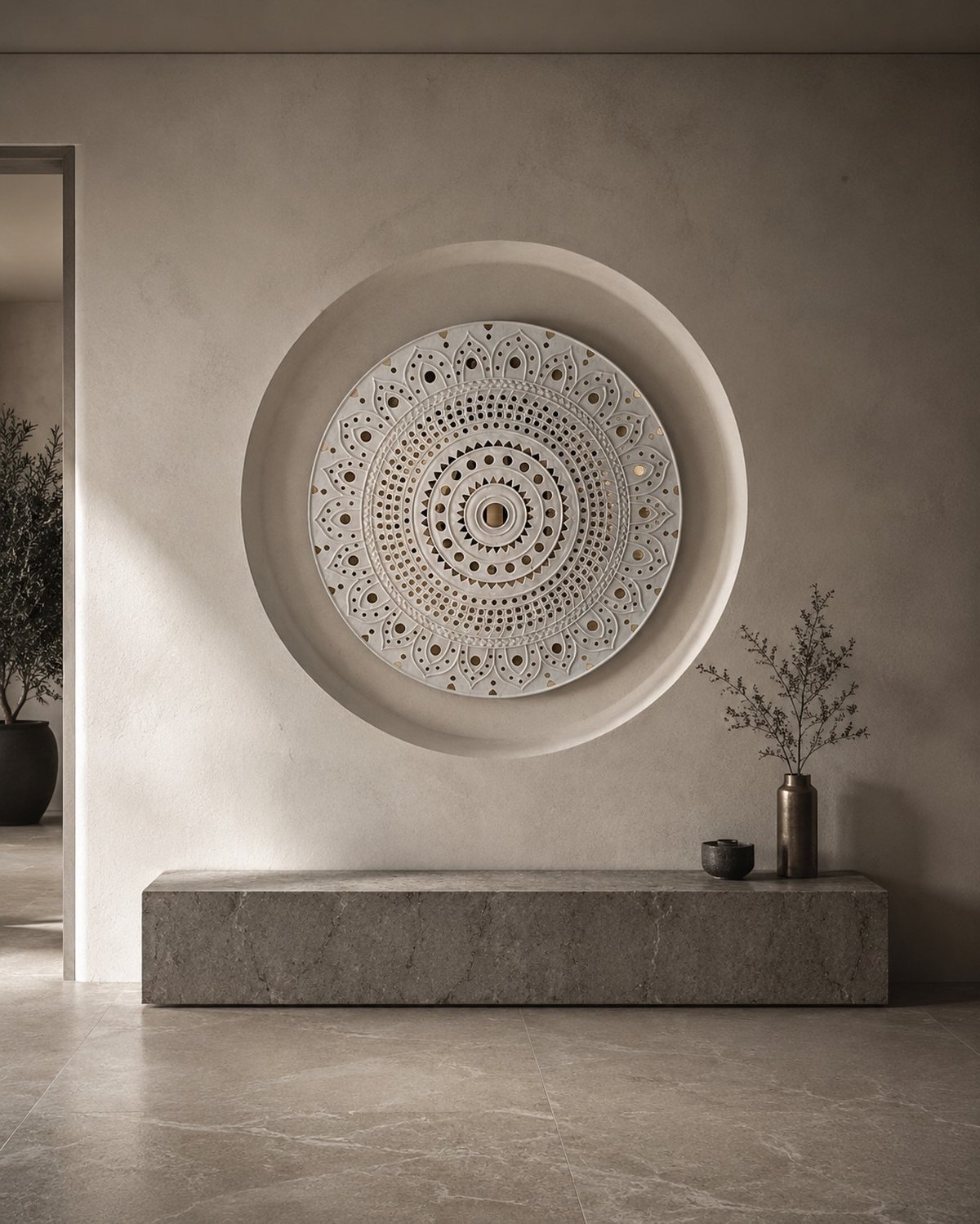
Custom jali that balances light, pattern and structural sense.
A jali is judged by its voids, but it survives because of the stone left between them. Pattern scale, bridges, edge distance, panel size, fixing and the chosen material are resolved before the first opening is cut.
01Made to orderDrawings and references developed for stone.
02Cut and hand-finishedMachined geometry resolved at the carving bench.
03Coordinated supplyApproval, numbering and packing planned for the work.
Marble jali, sandstone jali and pierced features
Stonegraph makes geometric, floral, traditional and contemporary jali for screens, gates, partitions, facade elements, mandir crowns, medallions, planters and architectural accents. The pattern can begin with an architect's vector file, a historical reference or a hand sketch.
Marble permits crisp, luminous edges; sandstone gives a softer and warmer screen. Both require adequate webs between openings, sensible margins around fixings and panel divisions that respect the pattern. The same drawing cannot simply be cut into every stone at every size.
What CNC does and what the hand corrects
CNC carving holds repeated geometry and alignment across panels. It is especially useful where a lattice continues over a long elevation or where hundreds of openings must meet the same profile.
After cutting, the edges, internal corners and surface are finished by hand. This removes the mechanically abrupt look, checks weak points and lets the face catch light consistently. Each screen is inspected before packing, with fragile open work braced differently from solid relief.
- Interior partitions and privacy screens
- Facade and window jali
- Mandir crowns and sacred surrounds
- Pierced medallions and feature panels
- Custom patterns from CAD, vector art or historical references
Information needed for a jali quotation
Send the overall opening size, intended panel divisions if the structure fixes them, indoor or outdoor exposure, stone preference, fixing concept and the pattern. If the pattern is not final, Stonegraph can assess references and advise what will remain strong at the required size.
For overseas supply, panels are numbered against the elevation and individually protected in reinforced crates. Installation stays with the client's local contractor, supported by the setting-out information prepared in Jaipur.
Practical answers
Questions before a stone brief.
- 01Can Stonegraph make a custom jali pattern?
- Yes. A pattern can come from CAD, vector artwork, an architectural reference or a sketch. It is redrawn for the panel size, stone, minimum web thickness, edges and fixing zones.
- 02Is marble or sandstone better for jali?
- Marble usually gives a crisper, brighter edge; sandstone gives a warmer surface. Panel size, exposure, thickness and pattern density are more important than a material name alone.
- 03Can stone jali be used outdoors?
- Yes, when the selected stone, thickness, drainage, structural support and fixing details suit the exposure. These conditions should be resolved with the project architect or engineer.
- 04How are fragile jali panels shipped?
- They are inspected, individually supported and braced in reinforced crates. Panels are numbered to match the setting-out drawing so the site team installs them in sequence.
Begin with what you have
Send the drawing, dimensions or reference.
Include the setting, preferred stone if known, quantity, delivery location and required date. The workshop can then respond with the missing technical questions.
Stonework directory
Find the right stonework brief.
Material, method and application guides from the Jaipur workshop.